
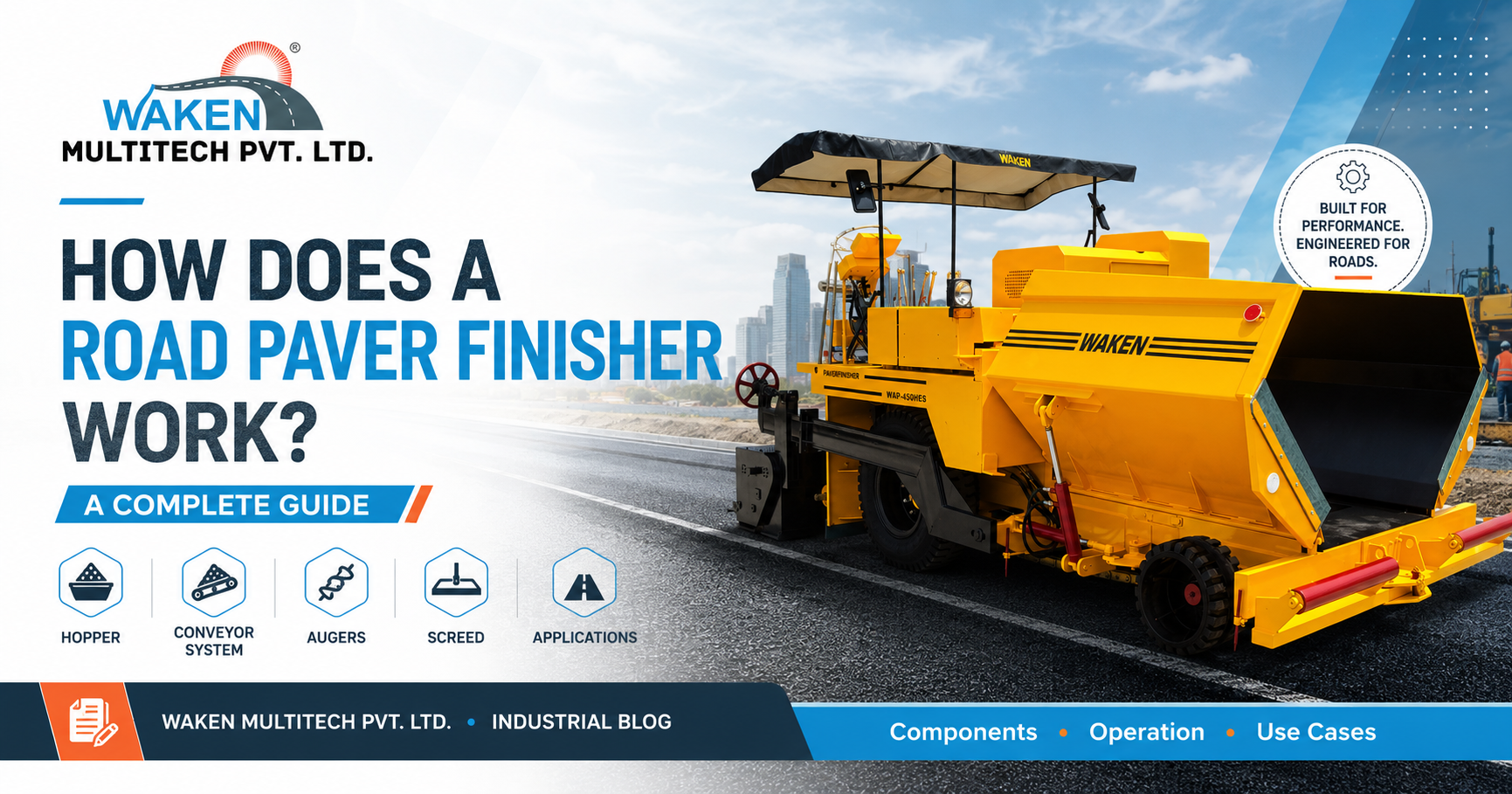
How Does a Road Paver Finisher Work? Complete Guide
Understand the complete working mechanism of a road paver finisher. Learn about its components, operation, and importance in modern road construction.
Why This Matters in Gujarat
Gujarat's rapid industrialization and expanding transportation network necessitate continuous road development and maintenance. The state's commitment to infrastructure growth means a constant demand for efficient and reliable road construction equipment. Paver finishers play a pivotal role in projects ranging from national highways and state roads to urban infrastructure development across Gujarat. Ensuring that this equipment functions optimally is key to meeting project deadlines and quality benchmarks, contributing directly to the state's economic vitality and connectivity.
What is a Road Paver Finisher? — Overview
A road paver finisher, often simply called an asphalt paver, is a specialized construction vehicle designed to lay asphalt concrete for road surfaces. It receives asphalt mix from a dump truck, meters it out evenly, and spreads it across the roadbed to a predetermined width and thickness. The machine's primary function is to create a uniform and consistent layer of asphalt, which is then compacted by rollers to form the final road surface. Modern paver finishers incorporate advanced technologies for precise control over material flow, screed operation, and grade.
Key Features and Technical Specifications
- Hopper: Receives and stores the asphalt mix from delivery trucks.
- Conveyor System: Transports the asphalt mix from the hopper to the screed.
- Augers: Distribute the asphalt mix evenly across the width of the screed.
- Screed: The crucial component that levels and strikes off the asphalt to the desired thickness and smoothness. It typically includes heating elements for optimal asphalt flow.
- Tamping/Vibrating Mechanism: Compacts the asphalt mix slightly within the screed for initial density.
- Drive System: Powers the movement of the machine and its internal components.
- Control Panel: Allows operators to manage speed, screed settings, material flow, and paving width.
- Sensor Systems (Optional): For automatic grade and slope control, ensuring consistent paving depth and crossfall.
Industrial Applications and Use Cases
- Highway Construction and Widening: Laying asphalt layers for new highways and expanding existing ones.
- Urban Road Paving: Constructing and resurfacing city streets, arterial roads, and bypasses.
- Airport Runways and Taxiways: Ensuring smooth, durable surfaces for aircraft operations.
- Industrial Estate Roads: Paving access roads within manufacturing and logistics hubs.
- Rural Road Development: Improving connectivity in agricultural and remote areas.
- Parking Lot Construction: Creating smooth and durable surfaces for commercial and private parking areas.
- Bridge Deck Surfacing: Applying asphalt layers to bridge decks for a seamless driving experience.
- Resurfacing and Overlay Projects: Applying a new layer of asphalt over existing road surfaces to extend their life and improve ride quality.
How to Choose the Right Road Paver Finisher
Selecting the appropriate road paver finisher is critical for project success. Consider these factors:
- Paving Width and Depth Requirements: Ensure the machine can achieve the necessary width and thickness for your specific project needs.
- Material Handling Capacity: The hopper size and conveyor system should match the expected volume of asphalt mix.
- Mobility and Maneuverability: Consider the job site conditions; some pavers are more suited for large, open areas, while others offer better maneuverability in confined spaces.
- Technology and Automation: Decide if basic mechanical controls are sufficient or if advanced sensor systems for grade and slope control are required for precision.
- Power and Engine Performance: The engine should provide adequate power for the intended applications, especially on inclines or with challenging mixes.
- Brand Reputation and Reliability: Choose manufacturers known for durable, high-performance equipment.
- After-Sales Support and Service: Availability of spare parts, maintenance services, and technical assistance is crucial for minimizing downtime.
- Operator Comfort and Ease of Use: A well-designed control station enhances operator efficiency and safety.
Quality Standards and Compliance
When selecting a road paver finisher, verifying compliance with relevant quality standards is paramount. Manufacturers should adhere to national and international standards for construction equipment, ensuring safety, durability, and performance. In India, this often includes adherence to Bureau of Indian Standards (BIS) specifications where applicable, although specific paver finisher standards may vary. Reputable manufacturers will often highlight their adherence to ISO certifications for quality management systems (e.g., ISO 9001).
Buyers should inquire about the materials used, manufacturing processes, and testing procedures employed by the manufacturer. Equipment that meets rigorous quality benchmarks is more likely to offer consistent performance, require less maintenance, and have a longer operational lifespan, ultimately contributing to the longevity and quality of the road construction project itself.
Why Waken Multitech's Experience and Capability Matters
With over 15 years of dedicated experience in manufacturing road construction equipment, Waken Multitech Pvt. Ltd. brings a deep understanding of the industry's demands. Our foundation, built by experienced professionals from the Apollo Group, ensures a legacy of technical expertise and a commitment to quality engineering. We focus on producing durable, high-performance machines that integrate advanced technology for precision and efficiency.
Our manufacturing facility on the Mehsana–Vijapur Highway is equipped to handle complex fabrication, allowing us to offer customized solutions tailored to specific project requirements. We implement stringent quality control measures throughout our production process, from material selection to final assembly. This dedication to quality, combined with our capability for innovation and responsive after-sales support, ensures that Waken Multitech equipment delivers reliable performance and contributes to the success of your road construction projects.
Installation, Maintenance and Care Tips
Proper installation and regular maintenance are key to maximizing the lifespan and performance of your road paver finisher. Upon delivery, ensure the machine is set up on a level surface and all operational checks are performed by trained personnel. Familiarize your operators with the control panel and operating procedures to prevent misuse.
Regular lubrication of all moving parts, as per the manufacturer's manual, is essential to reduce wear and tear. Inspect the hopper, conveyors, augers, and screed daily for any debris or damage. The screed plates and tamping bars should be kept clean and free from asphalt buildup, and their heating elements checked for proper function. Regularly inspect hydraulic fluid levels and filter conditions. Following the recommended maintenance schedule will prevent costly breakdowns and ensure consistent paving quality.
Frequently Asked Questions
Asphalt mix is typically delivered to the paver finisher by dump trucks. The trucks drive over the paver's hopper, and the mix is then discharged into it. From the hopper, a conveyor system transports the asphalt to the rear of the machine, where it is distributed evenly by augers.
The screed is the part of the paver finisher that actually lays and levels the asphalt. It is a heated plate that sits at the rear of the machine. It spreads the asphalt to the desired width and thickness and strikes off the surface to create a smooth finish before compaction by rollers.
Consistency in thickness is achieved through the precise adjustment of the screed's height and angle, often controlled by operator settings or automated sensor systems. These systems can monitor the grade of the existing surface or use string lines to maintain a uniform depth of asphalt across the paved area.
Yes, most road paver finishers are designed to handle a variety of asphalt mixes, including hot mix asphalt (HMA), warm mix asphalt (WMA), and stone mastic asphalt (SMA). However, specific mix designs may require adjustments to machine settings or specialized screed configurations.
A mechanical paver finisher uses a system of gears and chains for its drive and screed functions, offering robust performance. A hydrostatic paver finisher utilizes hydraulic fluid to power its movement and screed operations, providing smoother control, finer adjustments, and often better maneuverability and paving quality.
The temperature of the asphalt mix is critically important. It needs to be hot enough for the material to be workable and spreadable by the paver, but not so hot that it becomes unstable or loses its binder properties. The screed's heating system helps maintain optimal temperature at the point of paving.
Conclusion
Understanding the intricate workings of a road paver finisher reveals the sophisticated engineering involved in creating smooth, durable road surfaces. From the initial reception of asphalt in the hopper to the precise leveling by the screed, each component plays a vital role. Choosing the right paver finisher involves considering project-specific needs, technological capabilities, and the manufacturer's commitment to quality and support. By investing in reliable equipment and adhering to best practices in operation and maintenance, road construction projects can achieve superior results, contributing to safer and more efficient transportation infrastructure.
Get In Touch
Waken Multitech Pvt. Ltd.