
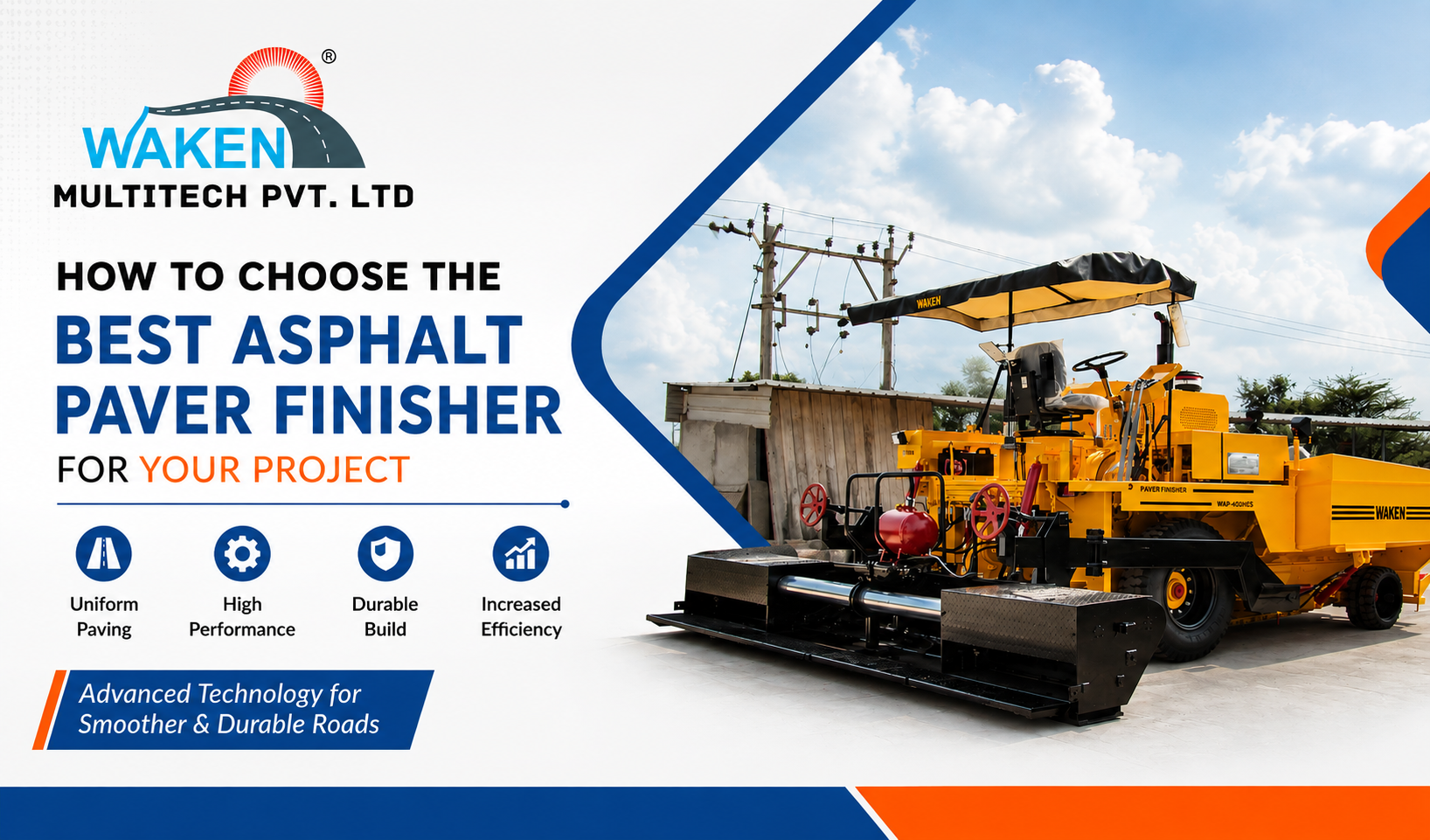
How to Choose the Best Asphalt Paver Finisher for Your Project
Embarking on a road construction or maintenance project requires careful planning, and a critical component of this process is selecting the right heavy machinery. Among the most vital pieces of equipment is the asphalt paver finisher. These machines are responsible for laying down a smooth, consistent, and durable asphalt surface, forming the foundation of our roads. Choosing the best asphalt paver finisher for your specific project is not a decision to be taken lightly, as it directly impacts efficiency, quality, and ultimately, the longevity of the finished roadway.
Waken Multitech Pvt. Ltd., with its over 15 years of technical expertise in road construction equipment, understands the nuances involved in selecting the perfect paver. Their specialization in manufacturing high-quality asphalt paver finishers, including models like the Multitech Asphalt Paver Finisher, Semi Sensor Paver Finisher, Mechanical Wet Mix Paver Finisher, and Hydrostatic Sensor Paver Finisher, stems from a commitment to durability, performance, and efficiency.
Key Factors for Selecting Your Asphalt Paver Finisher
The ideal asphalt paver finisher will vary significantly depending on the scope and demands of your project. Several key factors must be carefully evaluated:
Project Requirements & Scale
Consider the type of project: is it a major highway, a residential street, a parking lot, or minor repair work? Highway projects often require larger, more robust machines capable of high output and wide paving widths, whereas smaller jobs might be better suited to more compact units.
Paving Width and Mat Thickness
The required paving width dictates the size of the paver needed. Paver finishers come with different screed widths. Similarly, the desired thickness of the asphalt mat influences the paver's handling capabilities and the consistency of its output.
Site Access and Maneuverability
The physical constraints of the job site are important. Tight spaces, existing infrastructure, and traffic management needs might favor wheeled pavers for their maneuverability, while tracks offer superior stability on varied terrain.
Tonnage and Output Capacity
Understand the volume of asphalt mix you'll be laying and the pace required. Larger projects with tight schedules need pavers with higher tonnage capacity and consistent output to keep up with asphalt delivery.
Budget and Lifecycle Cost
While initial purchase price is a factor, also consider the long-term operational costs, including fuel consumption, maintenance, and potential downtime. Investing in a durable and efficient machine can lead to significant savings over time.
Technological Features
Modern paver finishers offer advanced features like sensor systems for automatic grade and slope control, which enhance accuracy and reduce the need for manual adjustments. Hydrostatic systems often provide smoother operation and better control.
Understanding Different Types of Asphalt Paver Finishers
Asphalt paver finishers are broadly categorized, and understanding these distinctions is key to selecting the right machine:
Track Pavers
Equipped with tracks, these machines offer excellent stability and weight distribution. They are ideal for large-scale projects, uneven or soft ground conditions, and situations where consistent traction is paramount. Their larger footprint helps prevent sinking into the asphalt mat.
Wheeled Pavers
Wheeled pavers are generally more maneuverable and easier to transport between job sites. They are well-suited for urban environments, smaller projects, and situations where frequent repositioning is necessary. Their mobility can be a significant advantage for contractors with diverse project portfolios.
Sensor Pavers
These pavers utilize advanced sensor technology (often laser or ultrasonic) to maintain precise grade and slope control. This automation leads to a smoother, more uniform mat and reduces the labor required for grade setting, making them efficient for projects demanding high accuracy.
Mechanical Pavers
Often simpler in design, mechanical pavers rely on mechanical linkages for functions like screed operation. While they may offer a lower initial investment, they might require more operator skill to achieve the same level of precision as sensor-equipped machines.
Practical Applications and Benefits
The application of an asphalt paver finisher is fundamental to modern infrastructure development. Properly choosing and operating a paver ensures:
- Smooth and Uniform Surfaces: Essential for driving comfort and reducing vehicle wear.
- Durability: A well-laid asphalt mat resists damage from traffic and weather, extending road life.
- Efficiency: Modern pavers, like those manufactured by Waken Multitech, are designed for high performance, reducing project timelines.
- Safety: Consistent surfaces improve vehicle handling and reduce accident risks.
Waken Multitech Pvt. Ltd. focuses on delivering equipment that embodies these benefits, leveraging their extensive technical expertise to create machines that are both reliable and efficient for various road construction scenarios.
Partner with Waken Multitech for Your Paving Needs
When selecting an asphalt paver finisher, consider the specific demands of your project. Waken Multitech Pvt. Ltd. offers a range of high-quality paver finishers designed for durability, performance, and efficiency. With over 15 years of technical expertise, we provide solutions tailored to meet the challenges of modern road construction. Explore our range of Semi Sensor Paver Finishers, Hydrostatic Sensor Paver Finishers, and more, designed to deliver exceptional results on your next project.
Let Waken Multitech's commitment to quality and expertise guide you to the best asphalt paver finisher for your needs. We also offer customized fabrication solutions and dedicated after-sales support to ensure your equipment performs optimally.
Frequently Asked Questions
What is the primary function of an asphalt paver finisher?
The primary function of an asphalt paver finisher is to evenly distribute and level hot asphalt mixtures onto a prepared base, creating a smooth and consistent surface for roads and other paved areas.
What is the difference between a track paver and a wheeled paver?
Track pavers offer superior stability and traction, especially on uneven or soft ground, making them suitable for large projects. Wheeled pavers are generally more maneuverable and easier to transport, making them ideal for smaller jobs or sites with limited space.
Why is the screed important in an asphalt paver?
The screed is a crucial component that follows the paver, leveling the asphalt mixture and providing initial compaction. Its width and ability to maintain consistent grade and slope are key to achieving a smooth and durable final surface.
How do sensor pavers improve paving quality?
Sensor pavers use automated systems (like laser or ultrasonic sensors) to control the screed's position, ensuring a highly accurate and consistent mat thickness and slope, even on uneven sub-bases. This reduces manual labor and enhances the final surface quality.
What should I consider about my project before choosing a paver?
You should consider the project's scale and type (highway, residential, etc.), the required paving width and mat thickness, site access constraints, the necessary tonnage or output capacity, and your budget, including long-term operational costs.