
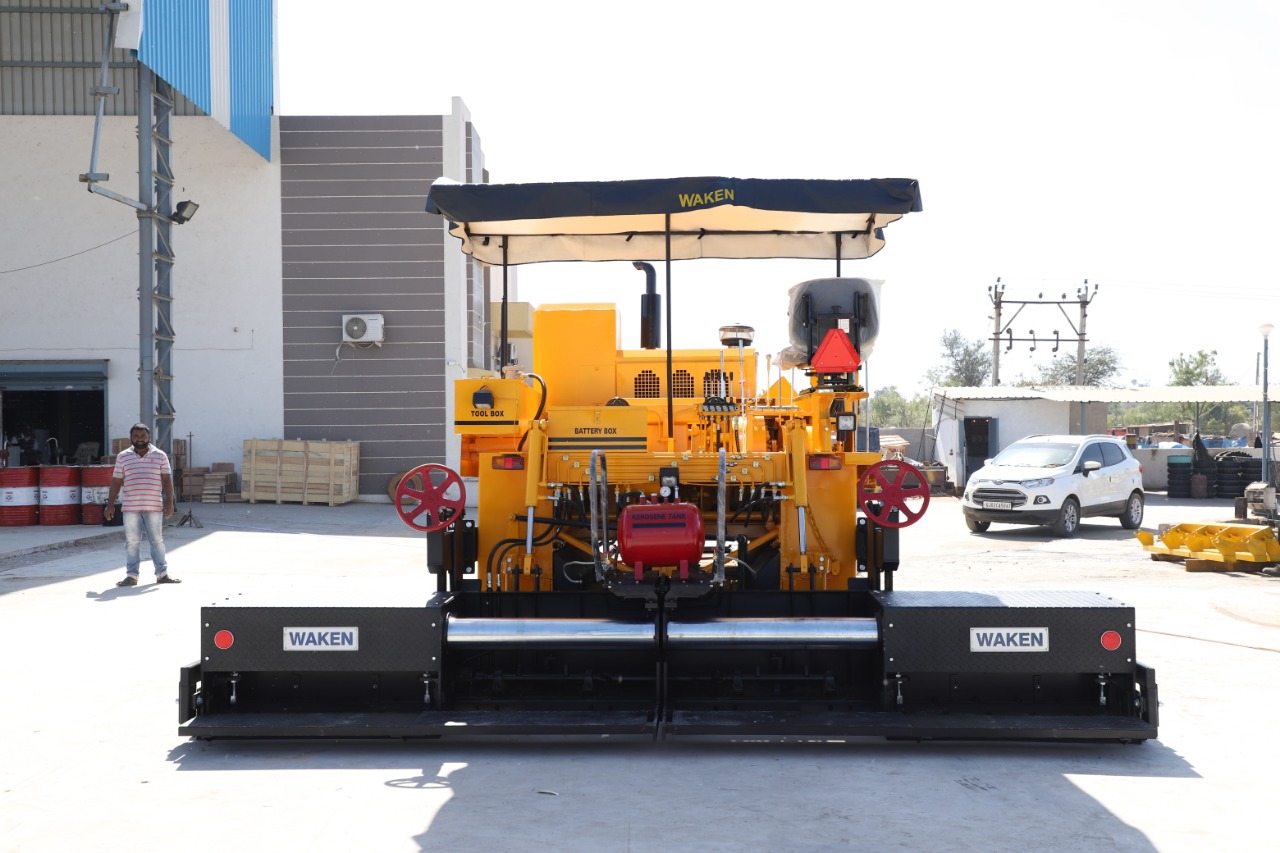
Hydrostatic Sensor Paver Technology Explained
Understanding the Core of Advanced Paving
The Hydrostatic Sensor Paver Technology Explained is a detailed look into the mechanics that allow modern road construction to achieve the highest standards of smoothness and longevity. This technology hinges on two primary, interconnected systems: the hydrostatic drive and the electronic grade and slope control system. Waken Multitech integrates both seamlessly to deliver a machine that is not just powerful but intelligently precise, meeting and exceeding MORTH specifications for highways and infrastructure projects across India.
The Hydrostatic Drive System Explained
Unlike older mechanical pavers that use clutches and gearboxes, the hydrostatic drive system transmits engine power through a hydraulic pump and motor combination, which drives the tracks or wheels. This offers infinitely variable speed control, allowing the operator to maintain a perfectly consistent, slow paving speed, crucial for an even mat without jolts or stops. The system's simplicity means fewer wear parts, leading to significantly higher reliability, reduced maintenance, and smoother, more continuous material flow from the hopper to the screed.
Components of Electronic Sensor Control
- Sonic Sensors: Non-contact sensors that use sound waves to measure the distance to a physical reference (like a string line, curb, or previous mat).
- Slope Sensors: Internal electronic components that measure the lateral tilt (cross-slope) of the screed, maintaining accurate drainage profiles.
- Controller Unit (ECU): The central brain that receives data from the sensors and calculates the exact, necessary adjustments for the screed.
- Proportional Hydraulic Cylinders: Actuators that receive commands from the ECU to instantly raise or lower the screed on either side.
- Auger Sensors: Monitor the material level in the auger channel to ensure consistent, balanced material flow in front of the screed.
How the Technology Ensures Precision
- Real-Time Closed-Loop Feedback: Sensors feed data to the controller, which immediately sends commands to the screed hydraulics, ensuring instant correction.
- Elimination of Operator Error: The automatic system takes over grade and slope adjustments, removing the human element from tedious, continuous corrections.
- Precision to Millimeters: Achieves tolerances far beyond manual methods, typically reaching accuracy of $\pm1$ mm for grade and $\pm0.05\%$ for slope.
- Consistent Mat Thickness: By referencing a datum, the paver ensures the exact specified volume of material is laid, leading to material cost savings.
- Superior Ride Quality: The resulting pavement surface minimizes the International Roughness Index (IRI), essential for modern highway standards.
Where Sensor Paver Technology is Essential
- Major Highway and Expressway Projects: Critical for achieving the required surface smoothness and longevity under heavy traffic loads.
- Airport Runways and Taxiways: Demands the highest levels of flatness and precise drainage slopes for aviation safety.
- Bridge Overlays and Decks: Requires controlled, uniform mat placement to manage structure weight and drainage effectively.
- Utility Trench Backfilling and Site Grading: Provides accuracy for preparing base layers before final pavement.
The Operational Advantages of Hydrostatic Sensor Pavers
- Optimal Fuel Efficiency: Hydrostatic systems are engineered for efficiency, providing power only as needed, saving on diesel consumption.
- Maximum Uptime: Fewer mechanical components mean less potential for costly breakdowns and more time spent paving productively.
- Flawless Surface Profile: The electronic sensor ensures that the finished mat has perfect grade and cross-fall for effective water runoff.
- Ease of Maintenance and Service: Simpler diagnostics and modular components make servicing and repairs quicker than complex mechanical gear trains.
Selecting a High-Tech Paving Partner
Choosing a manufacturer like Waken Multitech ensures you receive a paver where the Hydrostatic Sensor Paver Technology Explained translates into real-world performance. Our machines are built with internationally recognized electronic control systems (like MOBA), combined with robust, heavy-duty Indian engineering to deliver the best value and performance. We provide the necessary technical training to ensure your operators can harness the full potential of the automated systems, guaranteeing high-quality output on every project.
Troubleshooting Sensor Paver Issues
- If the screed fluctuates, first check the sensor reference line for obstructions, dirt, or movement.
- Verify that the hydraulic fluid level and temperature are within the optimal range, as this directly impacts hydrostatic performance.
- Ensure all electronic connectors and harnesses leading to the sensors are securely fastened and free from moisture damage.
- Recalibrate the slope sensor if paving results appear consistently uneven on a known level surface.
- Check the auger sensor feedback to prevent material starvation or surging, which can cause screed drag and finish defects.
FAQs – Hydrostatic Sensor Paver Technology
Contact Details
Talk to our specialists today for tailored solutions and fast assistance.