
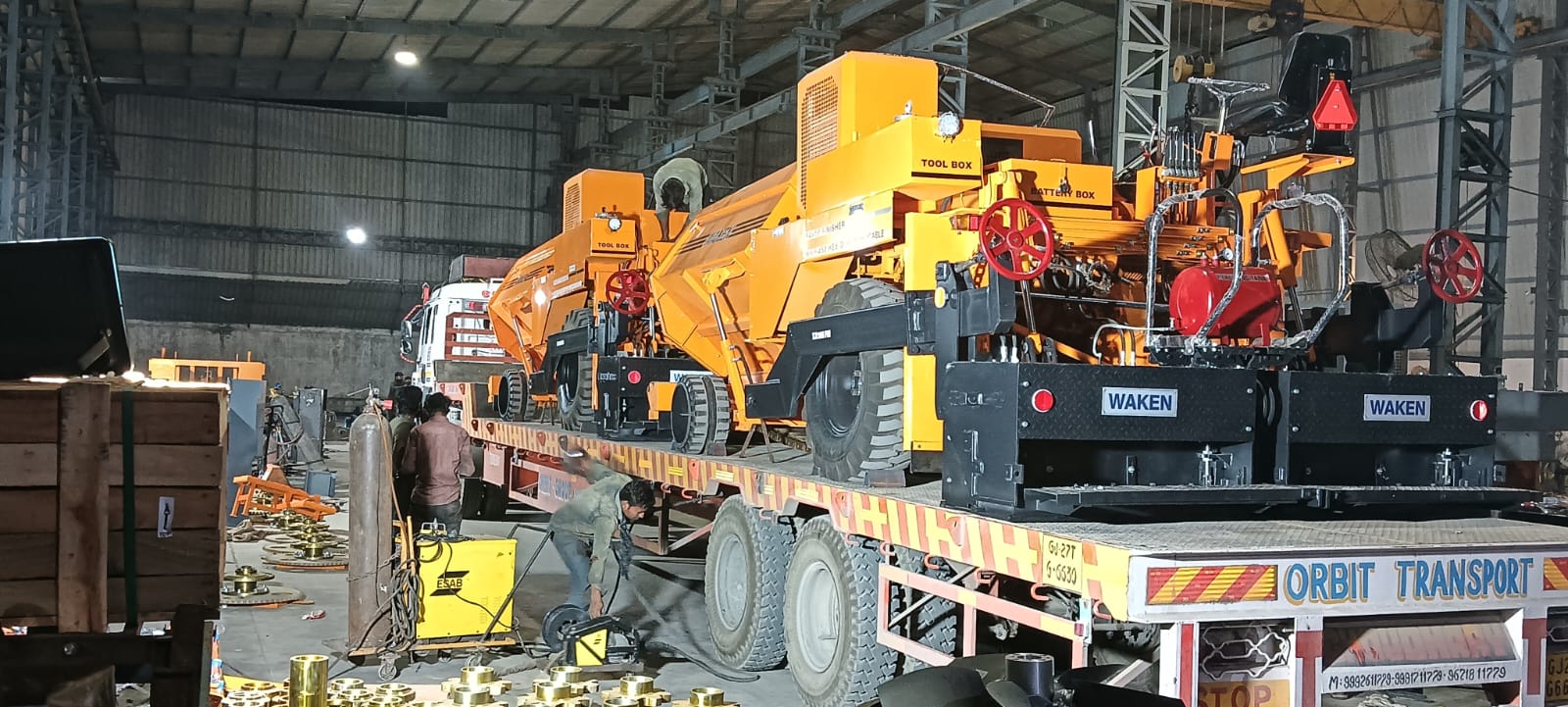
Integrating Advanced Wet Mix Paver Technology for Stability
Understanding Wet Mix Paver Technology
Wet Mix Paver Technology refers to the specialized engineering principles applied to machines that lay Wet Mix Macadam (WMM) and Granular Sub-Base (GSB) with unparalleled precision. This technology incorporates rugged mechanical systems, powerful hydrostatic drives, and sophisticated electronic grade controls. The primary goal is to handle the dense, coarse, and non-free-flowing nature of WMM material while achieving the high degree of mat accuracy and uniformity required for a stable road foundation. Waken Multitech leverages the latest in this technology to deliver machines that meet stringent Indian road construction standards. Discover our focus on innovative and robust paving solutions.
Key Technological Innovations in WMM Pavers
Modern Wet Mix Paver Technology focuses on maximizing material flow consistency and dimensional accuracy. Hydrostatic transmission provides infinitely variable speed control, which is crucial for a smooth laydown process, preventing surface disruptions. Advanced sensors (sonic or laser) work to automatically adjust the screed, ensuring the mat is laid at the exact grade and slope, minimizing thickness variation. Furthermore, the use of abrasion-resistant materials in the auger and screed components is a technological necessity to withstand the wear caused by granular base materials, ensuring long machine life.
Technological Systems Integration
- Hydrostatic Drive System: Offers reliable, low-maintenance power transmission for smooth, consistent traction and paving speed.
- Electronic Grade and Slope Control: Utilizes sensors to achieve precision paving, critical for meeting base course tolerance requirements.
- Heavy-Duty Material Flow Sensors: Automatically monitor and adjust the flow of dense WMM material to prevent material starvation or surging.
- Automated Screed Functions: Allows the operator to control extension, height, and tamper frequency with electronic precision.
- Integrated Diagnostics: Onboard computers monitor machine performance, helping operators and technicians troubleshoot issues quickly.
Design Elements Driven by Technology
- Tracked Traction Design: Advanced track systems ensure maximum flotation and even pressure distribution on loose sub-base materials.
- High-Frequency Tamping: Specialized screed technology is used to achieve higher initial compaction levels, reducing roller passes.
- Modular Screed Extensions: Allows for rapid width changes while maintaining a strong, uniform heat and tamper profile across the full width.
- Engine Management Systems: Modern engines are paired with smart controls for optimal fuel efficiency and power delivery under load.
- Operator Assistance Features: Technology enhances safety and efficiency through features like camera systems and simplified control interfaces.
Impact of Advanced Technology on Paving Projects
- High-Speed Corridor Construction: Allows for continuous paving operations with minimal breakdown, significantly improving project timelines.
- Quality Assurance and Compliance: Automated grade control ensures compliance with strict quality specifications for base course thickness and elevation.
- Infrastructure Durability: A precisely laid, uniform base layer is the technological key to increasing the overall lifespan of the road or pavement.
- Resource Optimization: Accurate material laying prevents the costly waste of WMM or GSB materials, maximizing budget efficiency.
Core Advantages of Modern Paver Technology
- Enhanced Pavement Foundation: Technology ensures a dense, highly accurate base that supports the upper layers effectively.
- Superior Operational Control: Hydrostatic and electronic systems give the operator fine-tuned control over the paver's functions.
- Reduced Machine Downtime: Durable components and integrated diagnostics minimize maintenance issues and speed up repairs.
- Increased Hourly Output: The combination of powerful drives and continuous material flow technology maximizes daily paving production.
The Future of Wet Mix Paving Technology
The trend in Wet Mix Paver Technology is moving towards even greater automation and integration. Future innovations will include full 3D paving control using GPS and total stations, eliminating string lines entirely. Furthermore, advancements in telematics will allow for real-time monitoring of machine health and production statistics, enabling contractors to manage their fleet and projects with unprecedented efficiency. Waken Multitech is committed to incorporating these next-generation technologies into its equipment portfolio.
Technical Maintenance of Advanced Paver Systems
- Perform diagnostic checks on the electronic grade control system regularly to ensure all sensors are communicating accurately.
- Always use the recommended high-quality hydraulic fluids and filters to protect the precision components of the hydrostatic system.
- Check the tamping bar and vibrating components of the screed for wear, as their mechanical integrity is crucial for initial density.
- Keep all electrical connections to the electronic controls clean and protected from moisture and dust, which can interfere with signals.
- Train maintenance staff specifically on the paver's control software and electronic diagnostics for quick and precise troubleshooting.
FAQs – Wet Mix Paver Technology
Contact Details
Talk to our specialists today for tailored solutions and fast assistance.