
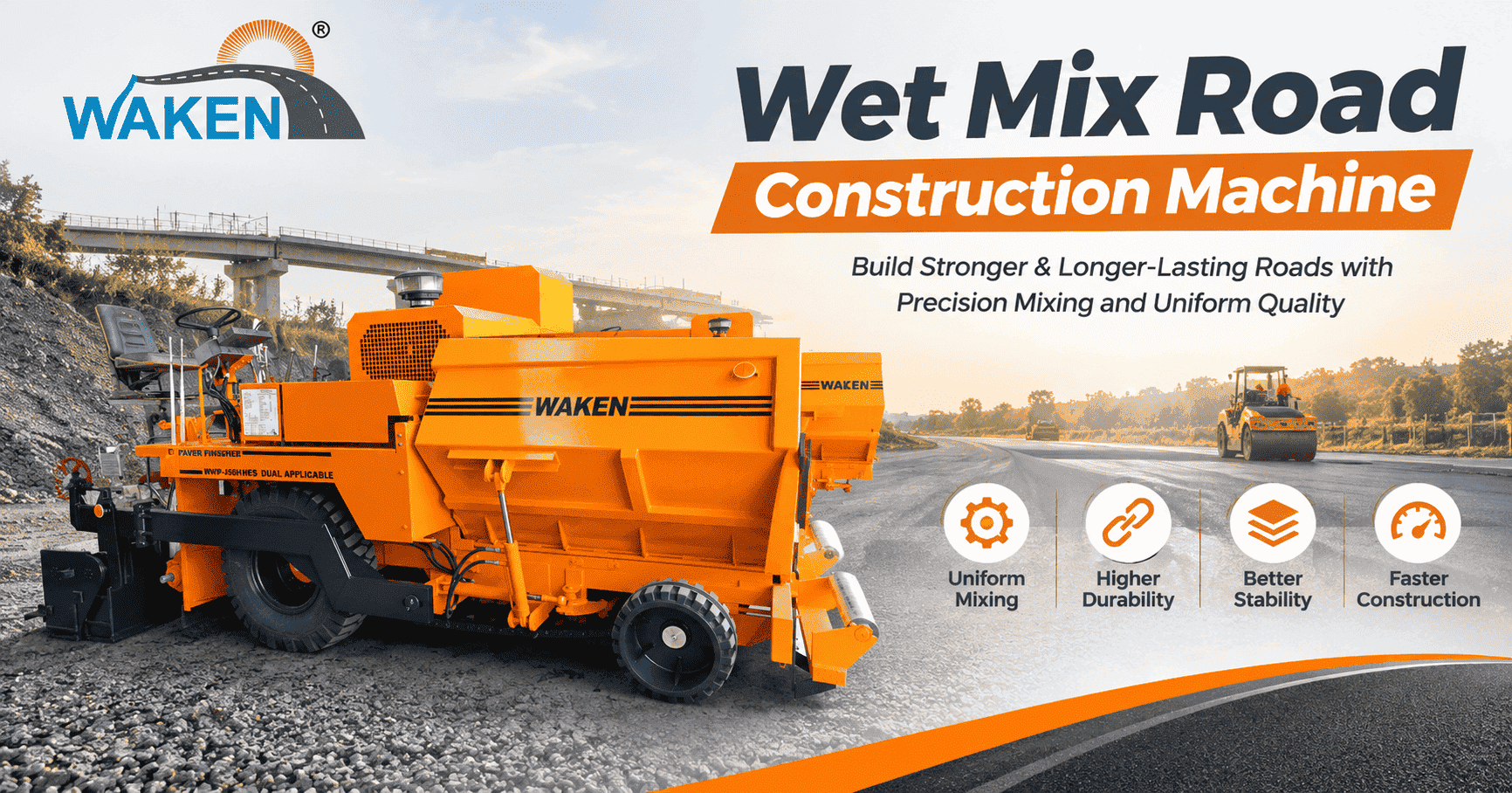
Wet Mix Road Construction Machine
The foundation of any durable road lies in the quality of its base layers. A Wet Mix Road Construction Machine, commonly known as a Wet Mix Macadam (WMM) plant, plays an indispensable role in achieving this by preparing a precisely controlled, uniformly mixed blend of aggregates and water. This ensures the pavement structure possesses the necessary strength, stability, and longevity required for modern infrastructure. Waken Multitech Private Limited, with its deep technical expertise, offers reliable solutions for road construction needs.
Understanding Wet Mix Road Construction
Wet Mix Macadam (WMM) is a crucial layer in road construction, typically applied as the base or sub-base course. It involves mixing graded aggregates with a controlled amount of water to achieve a specific moisture content before compaction. This process is vital for creating a dense, well-bound layer that provides excellent load-bearing capacity and resistance to water infiltration. A dedicated Wet Mix Road Construction Machine is engineered to perform this task efficiently and uniformly, setting the stage for a high-quality road surface.
The importance of precise mixing cannot be overstated. Variations in aggregate gradation or moisture content can lead to premature pavement failure, including rutting, cracking, and disintegration. Therefore, utilizing a sophisticated WMM plant is essential for meeting stringent construction standards and ensuring the long-term performance of the road network.
Key Components of a WMM Plant
A typical Wet Mix Road Construction Machine comprises several key units that work in synergy to produce the WMM material:
- Cold Aggregate Feeders: These units control the flow of different sizes of aggregates into the mixing process. They are often designed for manual gate control in mechanical plants, allowing for precise batching.
- Vibratory Screen: Placed after the feeders, a vibratory screen ensures the aggregates are correctly graded and removes oversized or undersized particles.
- Conveyor Belts: These transport the aggregates from the feeders and screen to the mixer, ensuring a continuous flow.
- Pug Mill Mixer: This is the heart of the WMM plant, where aggregates and water are thoroughly blended. Many advanced pug mills feature multiple shafts (e.g., 6 shafts) for enhanced mixing efficiency, better torque absorption, and reduced maintenance.
- Water Tank and Pumping System: This system precisely meters and sprays water onto the aggregates within the pug mill to achieve the target moisture content.
- Control Cabin: Equipped with controls for operating the feeders, belts, mixer, and water system, allowing for efficient monitoring and management of the production process.
- Storage Silo (Optional): Some plants may include a silo to temporarily store the mixed WMM material, especially for continuous paving operations.
Diverse Applications of WMM Plants
The versatility and effectiveness of WMM plants make them suitable for a wide range of road construction projects:
Highways & Expressways
Provide a strong, stable base for high-volume traffic and heavy loads.
Urban & Rural Roads
Enhance durability and longevity for everyday transportation needs.
Airport Runways
Ensure consistent and high-strength surfaces capable of withstanding aircraft loads.
Railway Infrastructure
Used for service roads and ballast support layers in railway construction.
Industrial & Port Roads
Construct robust surfaces for heavy-duty vehicles and material handling equipment.
Advantages of Using a Wet Mix Road Construction Machine
Employing a dedicated WMM plant offers significant advantages over traditional methods or less sophisticated equipment:
- Uniformity and Consistency: Ensures precise control over aggregate gradation and moisture content, leading to a homogenous mix batch after batch.
- Enhanced Durability: The uniformly compacted WMM layer provides superior load-bearing capacity and resistance to environmental factors, extending road life.
- Improved Stability: A well-prepared WMM base prevents rutting and deformation, maintaining the road's structural integrity.
- Faster Project Completion: High production efficiency allows for rapid preparation of base materials, accelerating construction timelines.
- Cost-Effectiveness: Optimized material usage and reduced rework contribute to overall project economy.
- Better Pavement Performance: WMM roads are known to be more durable and dry faster than Water-Bound Macadam (WBM) roads, enabling quicker opening to traffic.
Selecting the Right Wet Mix Road Construction Machine
Choosing the appropriate Wet Mix Road Construction Machine is a critical decision that impacts project efficiency, quality, and cost. Consider the following factors:
Buyer Insight
Before making a purchase, clearly define your project's scale, expected production volume, and the types of aggregates you will be using. Understanding the operational environment and logistical constraints will help pinpoint the most suitable machine configuration.
| Consideration | Key Questions to Ask | Impact on Your Project |
|---|---|---|
| Production Capacity | What is the required hourly output (TPH)? Does the plant need to handle varying project sizes? | Ensures the machine can meet project timelines without being a bottleneck. |
| Mixing Efficiency | What is the design of the pug mill? How many shafts does it have? How is water precisely metered? | Determines the uniformity and quality of the WMM mix, crucial for road durability. |
| Mobility & Setup | Is a fixed, mobile, or semi-mobile plant required? How easy is it to transport and erect? | Impacts logistical costs, setup time, and suitability for multiple or remote project sites. |
| Operator Skill & Maintenance | How user-friendly is the control system? What are the maintenance requirements? Are spare parts readily available? | Affects operational costs, uptime, and the ease of integration into your existing fleet. |
| Durability & Build Quality | What materials are used in construction? What is the track record of the manufacturer? | Ensures long-term reliability and return on investment, minimizing downtime. |
Waken Multitech: Expertise in Road Construction Equipment
Established on March 12, 2015, Waken Multitech Private Limited brings over 15 years of dedicated technical expertise to the manufacturing of high-quality road construction equipment. The company is committed to delivering products that excel in durability, performance, and efficiency, meeting the demanding standards of modern infrastructure projects. Waken Multitech offers a range of paver finishers, including Mechanical Wet Mix Paver Finishers, designed to cater to various road construction requirements. Their focus on robust engineering and reliable operation ensures that contractors receive equipment capable of producing consistent, high-quality WMM material, essential for building long-lasting roads.
Ensuring Quality in WMM Production
Maintaining the quality of the Wet Mix Macadam layer is paramount. This involves rigorous checks throughout the production and application process:
- Aggregate Gradation: Regularly verify that the aggregates used conform to the specified sieve analysis.
- Moisture Content: Continuously monitor and adjust the water added to achieve the target moisture content, typically within a narrow band specified by the project engineer.
- Mixing Uniformity: Observe the pug mill operation to ensure thorough blending of aggregates and water. Periodic checks of discharged material for homogeneity are recommended.
- Equipment Calibration: Ensure feeders, weigh scales (if applicable), and water metering systems are regularly calibrated for accuracy.
- Field Compaction: Once laid, the WMM layer must be compacted to the required density as per project specifications, often monitored through nuclear density gauges.
Frequently Asked Questions about WMM Machines
What is the primary difference between a WMM plant and an Asphalt Mixing Plant?
A WMM plant mixes aggregates with water to create a base or sub-base layer, focusing on moisture control. An Asphalt Mixing Plant, on the other hand, mixes aggregates with hot bitumen binder at elevated temperatures to produce the wearing course or binder course of the pavement.
Are mechanical WMM plants less efficient than sensor-based ones?
Mechanical WMM plants are typically simpler to operate and maintain, making them cost-effective for many applications. Sensor-based or hydrostatic plants offer higher precision and automation, which can lead to greater consistency and efficiency, especially for large-scale projects.
What are the advantages of WMM roads over traditional Water-Bound Macadam (WBM) roads?
WMM roads offer superior durability, better load-bearing capacity, and improved resistance to water damage compared to WBM roads. They also tend to dry faster, allowing for quicker opening to traffic and reduced construction delays.
Can a WMM plant be used for different types of aggregates?
Yes, WMM plants are designed to handle a range of aggregate sizes and types. However, it's crucial to ensure the plant's feeders and mixer are suitable for the specific gradation and characteristics of the aggregates being used for optimal performance.
Ready to Enhance Your Road Construction Projects?
Explore how Waken Multitech Private Limited's expertise in road construction equipment can benefit your next project. Discover reliable solutions designed for durability and performance.
Visit Waken Multitech